Tor was not joking around this month. Two short stories and four novelettes makes this the biggest release month they’ve had in a while, and the works range from tie-ins to larger settings to some very stand alone. Fans of Tamsyn Muir and Seanan McGuire (of which there are many, I know) will be happy that they return to popular series, and there’s some interesting works interrogating uploaded consciousnesses, mythical games, and the deteriorating nature of reality itself. There’s a lot to enjoy, and a lot to get to, so I’ll cut this short and just jump into the reviews!
It’s the second month of Uncanny Magazine’s Disabled People Destroy Science Fiction! As before, I’m breaking October’s offerings into two parts, the fiction and the poetry, and starting out with the six new stories exploring futures near and far. This month’s pieces definitely focus on some grim realities—hospitals and universities and families and cities where disabled people are not exactly the priority, or at least not in the ways they want. The stories look at characters trapped by circumstance and (largely) by tragedy, brought to a crisis because their situation is getting worse and worse. And in each case, they must make decisions either to sit down and be quiet or to fight back, to try to follow their own hearts. The works are often dark, often difficult, but ultimately I feel reaching for healing and for peace, for a space that the characters can have as their own, which is much more about freedom than confinement. To the reviews!
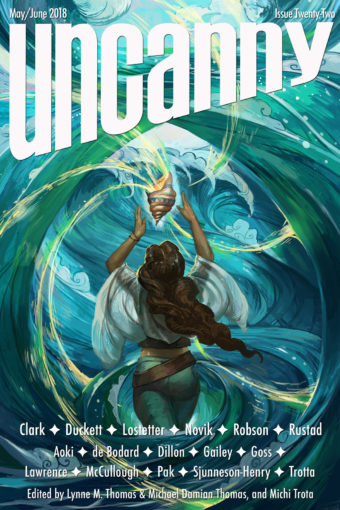
The May fiction and poetry from Uncanny Magazine has something of a yearning quality to me. The pieces deal with desire, and with longing, and with reaching both backwards in time and forward. Memory and comfort, lust and power all mix and mingle here with characters who want to find something that seems to be missing in their lives, some vital spark that can’t seem to light in the environment they find themselves in. So they must move, or seek aid, or change their environments to better suit their needs. The stories are on the short side, the poetry very concerned with myth and women, and the issue as a whole is a wonderful way to usher in the arrival of warmer weather. Let’s get to the reviews!
December’s Apex Magazine
looks at the end of the world, or at least two visions of it. Two very
different visions of it. And yet both look at how people face
destruction and the prospect of having broken a system so wholly that
there might not be any going back. In one story, though, humanity has
destroyed the Earth through what might be negligence, or might be random
chance, and in the other it comes from hubris, from pushing too far,
too fast, even after having prevented environmental ruin. The stories
look at characters faced with knowledge of the end and how they adapt,
what they reach for. Comfort, perhaps, but mostly other people.
Community. A way to work together in order to perhaps salvage something
from the end. And maybe even do something about it. Before I give too
much away, though, to the reviews!