 |
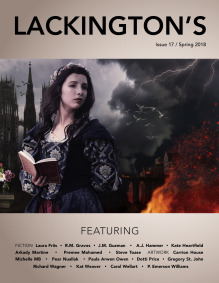
| Art by Richard Wagner |

Short(ish) Reviews of Speculative Short Fiction, Poetry, and Nonfiction. Word counts are approximate. Opinions are my own. (also, probably SPOILERS ABOUND!)
Showing posts with label Amal El-Mohtar. Show all posts
Showing posts with label Amal El-Mohtar. Show all posts
Friday, May 25, 2018
Quick Sips - Lackington's #17 [Gothics]
It’s a huge issue of Lackington’s out this month, focusing on the Gothic. And from literal Ostrogoths to exquisite corpses, there’s a lot to see and a lot of amazing interpretations of the theme. There are eight original stories (and a reprint that you should definitely check out but that I’m not reviewing this time) and each of them feature themes and settings that embrace the Gothic aesthetic. Haunted houses, neglected estates, and isolated villages all make the stories ripe with shadows that just might swallow up the unwary traveler. These are pieces about facing the strange and the dangerous, the supernatural and the all-too-human. And, well, not always coming out the other side. There’s a great mood to these stories that really gets at the heart of the theme, and it’s a fantastic way to explore what is one of the oldest kinds of SFF stories. So let’s get to it!

Friday, February 16, 2018
Quick Sips - Strange Horizons 02/05/2018 & 02/12/2018
February brings a touch of the weird and rather literary to Strange Horizons, and the first two issues each feature a story and a poem that explore violation, bodies, and exposure. For me, the stories have a dense, rather poetic quality to them, the sense of reality bent around metaphor and pain. There's a heavy weirdness to them as well, with people becoming bears, bodies becoming art, and an all around just kind of uncomfortable/icky feel to things (I know icky is like the most literary of terms, right?). But there's a sharpness to the discomfort, an edge to the disturbing that these pieces reveal. And the poems are as always deep and layered and interesting and let's just get to the reviews!
 |
| Art by Dan Rempel |
Thursday, February 1, 2018
Quick Sips - Fireside Magazine January 2018
It’s a rather packed start to 2018 at Fireside Magazine, which sort of goes against its url a bit in dipping into some poetry this month. With five short stories, a poem, and the final chapter in the gripping and wrenching novelette that’s been playing out the last few months, there’s a lot to take in, and the works range from speculative takes on the future of genetic manipulation and identity to fantasy worlds ruled by cruel gods to a literary examination of immigration and vulnerability. Basically, the works cover a lot of ground, united by their sharp gaze and moving styles, not by their tone or subjects. Taken as a whole, it’s a group of works that find a nice balance, some fun and sweet, some pitch black and difficult. So yeah, let’s get to the reviews!
 |
| Art by Tesslyn B |
Monday, April 3, 2017
Quick Sips - Tor dot com March 2017
First I guess I have to talk about Tor dot com's March project, Nevertheless, She Persisted, which features eleven pieces of flash fiction all centered around that idea, that quote. These are stories that hit and hit hard, some of them blisteringly defiant and some of them steeped in despair. The stories (and poem) show the many facets of the idea of persistence. The power of it and also the crushing nature of having to persist, and persist, and persist, ever and always. The stories run across a wide range of speculative genres and it's wonderful to see the authors taking this central idea and being inspired by it. Using it to say something new and interesting. Making a statement on our current situation and refusing to look away from the uncomfortable truths of it. So yes, it's a wonderful project and makes for a some surprising start to Tor's March.
That's not all that the publication got up to, though. Oh no. This would have been a full month even without the eleven flash stories, as there are also three short stories and two novelettes to look at. And wow. These are some gorgeous pieces that take on some deeply uncomfortable themes and manage to find glimmers of hope even in the most devastating of loss and corruption. They are stories of ghosts and magic, bodies and wars. And before I get too lost in describing them, why don't I just get to the reviews!
 |
| Art by Scott Bakal |
Wednesday, October 14, 2015
Quick Sips - Uncanny #6 (October Stuff)
In a month that is dominated by the spooky, the dark, Uncanny Magazine presents a nice array of stories, poetry, and nonfiction that are...reaching. Not light, perhaps, but dense rather than dark, yearning rather than scary. Most of the works have a delicious way of not offering closure, not really offering answers. The endings are all lingering promises. Even the nonfiction doesn't offer a solution to everything, more highlights a problem and a possible direction to go and allows the reader to follow onward, to make the steps themself. It makes for a lovely issue that I should just get to reviewing.
 |
Art by Matthew Dow Smith
|
Wednesday, June 17, 2015
Quick Sips - Lightspeed #61 QUEERS DESTROY SCIENCE FICTION (part 2: the full-length Fiction!)
Okay, so apparently I miscounted when I originally said how many original fiction pieces were in Lightspeed Magazine's Queers Destroy Science Fiction. I had said there were ten stories. There are eleven. Eleven stories that are all worth checking out. I mean, wow. There is so much good fiction here. From stories dealing with the end of the world and cataclysmic war to seemingly smaller (or at least a bit more personally important) moments dealing with online harassment and the loss of a parent, the stories range wide and far. Characters are richly diverse, stories at turns funny and uplifting and heartbreaking and tragic. There is so much to like. So let's get to it!
 |
Art by Elizabeth Leggett
|
Monday, February 2, 2015
Quick Sips - Uncanny #2 (February Stuff)
And here is the second part of the Uncanny #2 review that started last month. For those wanting to catch up, check that out here. Anyway, this second half is more full of stories but lighter on poetry and non-fiction. Still well worth checking out, though, so if you haven't picked up your very own copy, maybe go do that.
Stories:
"Pockets" by Amal El-Mohtar (3216 words)
A story about a woman who finds that she can pull things from her pockets. Any pockets, and really just about any thing. It's an interesting idea, and when she gets a friend to help her scientifically analyze what's going on, it opens up all sorts of weird questions about where the items are coming from and what she's supposed to do with them. And then she finds a person whose pockets only take things in and together they find a way to get rid of all the things that have been coming out of the one set of pockets...by putting them into the other set. Of course, then the question is where do they go from there. And through is the idea of connection, and of art, and of creation itself. I got the idea that part of what the story was about was finding artifacts (like this story) after the owner has let them go or lost them (or, I guess, sold and published them). It's about how a person can find them, and pass them on again. It's about finding meaning in those items, about connecting through those items, and ultimately about letting them go again, comforted by the idea that they are for whoever finds them, and for whoever finds them after that. For me it's a story about stories, about how these words can be personal to every person, can hit each person differently, and never really lose their power. The message the main character receives in the end wasn't for her specifically, but it was for her because she found it. Interesting stuff.
"Anyone with a Care for Their Image" by Richard Bowes (1322 words)
I actually read this before the story that appeared in Farrago's Wainscot in January, but as the review is coming out now I can say that it's set in the same world, in the Big Arena series, but earlier in the chronology. Here a social media persona finds himself in danger as tensions flare into something big and he makes some mistakes in how he covers the events unfolding around him. This is a story about how certain people, despite being "in the middle of things" are essentially cut off from humanity. They are trend setter and followed by a great many people, but they are also so far removed from the people that follow them that they don't really understand the realities of the world. Especially the inequalities and hardships that they are insulated from. And even when they are reminded, they have a way of getting away, of having the chance to rebrand themselves again and again and survive to plague people once more. They survive because despite the hardships, things don't really change all that much. Their wealth and influence and privilege allows them to try and sell a new snake oil. I'm not sure that I liked this story as much as "Time is a Twisting Snake" but they definitely fit together thematically.
"Love Letters to Things Lost and Gained" by Sunny Moraine (3737 words)
This was my favorite story of the issue. Part of me just can't help loving how stubborn the main character is, how justifiably hurt and angry she is at her situation. It strikes me as so human, as so real. Because dealing with the loss of a limb sounds like it would be terrible, and there is that sense that the world does value what is whole in a way to erase the wounds, to tell a person to get over it and move on so that the world doesn't have to recognize or react to that loss. That the world can basically sit back and say, "yes yes, but you're better now, so get over it." And there is a power in saying no, in forcing people to deal with the scars, with the reality of what happened. To make people see it and be confronted. Because to erase it back to the way it was would not really erase the trauma. It would not make things whole again. It would be to lie for the sake of the world's comfort, and really, fuck that. So I love the story, and I love how the main character becomes more comfortable with what happened but refuses to erase it, refuses to fall for the trap of letting the world pretend it never happened. It's a powerful story about how survivors are not at fault for being uncomfortable, or being hurt. That they own their own bodies, their own choices. And the story is just lovely and powerfully written and good.
Poetry:
"archival testimony fragments / minersong" by R.B. Lemberg
This is a nice, disjointed poem, about a living ship trapped underground and calling out to miners that are working the surface of its now-dead world. It's an interesting mix of voices, mostly the ship's but with the voices from above, as well, the training instructions from the company that owns the planet and the voice of one of the miners who hears the voice calling out and decides to try and respond. In some ways this read to me as a poem about the power of history and workers. Because the ship is seeking to empower the miners, is seeking to join forces with them. At least, I got a bit of the sense that the company was exploiting them both and that the ship wanted to help the miners escape, if that meant it could also escape. To end the circle of exploitation and allow people to escape the captivity beneath the surface. Or I could be way off. But it was a good read with a unique style.
 |
| Art by Julie Dillon |
Stories:
"Pockets" by Amal El-Mohtar (3216 words)
A story about a woman who finds that she can pull things from her pockets. Any pockets, and really just about any thing. It's an interesting idea, and when she gets a friend to help her scientifically analyze what's going on, it opens up all sorts of weird questions about where the items are coming from and what she's supposed to do with them. And then she finds a person whose pockets only take things in and together they find a way to get rid of all the things that have been coming out of the one set of pockets...by putting them into the other set. Of course, then the question is where do they go from there. And through is the idea of connection, and of art, and of creation itself. I got the idea that part of what the story was about was finding artifacts (like this story) after the owner has let them go or lost them (or, I guess, sold and published them). It's about how a person can find them, and pass them on again. It's about finding meaning in those items, about connecting through those items, and ultimately about letting them go again, comforted by the idea that they are for whoever finds them, and for whoever finds them after that. For me it's a story about stories, about how these words can be personal to every person, can hit each person differently, and never really lose their power. The message the main character receives in the end wasn't for her specifically, but it was for her because she found it. Interesting stuff.
"Anyone with a Care for Their Image" by Richard Bowes (1322 words)
I actually read this before the story that appeared in Farrago's Wainscot in January, but as the review is coming out now I can say that it's set in the same world, in the Big Arena series, but earlier in the chronology. Here a social media persona finds himself in danger as tensions flare into something big and he makes some mistakes in how he covers the events unfolding around him. This is a story about how certain people, despite being "in the middle of things" are essentially cut off from humanity. They are trend setter and followed by a great many people, but they are also so far removed from the people that follow them that they don't really understand the realities of the world. Especially the inequalities and hardships that they are insulated from. And even when they are reminded, they have a way of getting away, of having the chance to rebrand themselves again and again and survive to plague people once more. They survive because despite the hardships, things don't really change all that much. Their wealth and influence and privilege allows them to try and sell a new snake oil. I'm not sure that I liked this story as much as "Time is a Twisting Snake" but they definitely fit together thematically.
"Love Letters to Things Lost and Gained" by Sunny Moraine (3737 words)
This was my favorite story of the issue. Part of me just can't help loving how stubborn the main character is, how justifiably hurt and angry she is at her situation. It strikes me as so human, as so real. Because dealing with the loss of a limb sounds like it would be terrible, and there is that sense that the world does value what is whole in a way to erase the wounds, to tell a person to get over it and move on so that the world doesn't have to recognize or react to that loss. That the world can basically sit back and say, "yes yes, but you're better now, so get over it." And there is a power in saying no, in forcing people to deal with the scars, with the reality of what happened. To make people see it and be confronted. Because to erase it back to the way it was would not really erase the trauma. It would not make things whole again. It would be to lie for the sake of the world's comfort, and really, fuck that. So I love the story, and I love how the main character becomes more comfortable with what happened but refuses to erase it, refuses to fall for the trap of letting the world pretend it never happened. It's a powerful story about how survivors are not at fault for being uncomfortable, or being hurt. That they own their own bodies, their own choices. And the story is just lovely and powerfully written and good.
Poetry:
"archival testimony fragments / minersong" by R.B. Lemberg
This is a nice, disjointed poem, about a living ship trapped underground and calling out to miners that are working the surface of its now-dead world. It's an interesting mix of voices, mostly the ship's but with the voices from above, as well, the training instructions from the company that owns the planet and the voice of one of the miners who hears the voice calling out and decides to try and respond. In some ways this read to me as a poem about the power of history and workers. Because the ship is seeking to empower the miners, is seeking to join forces with them. At least, I got a bit of the sense that the company was exploiting them both and that the ship wanted to help the miners escape, if that meant it could also escape. To end the circle of exploitation and allow people to escape the captivity beneath the surface. Or I could be way off. But it was a good read with a unique style.
Thursday, January 29, 2015
Quick Sips - Strange Horizons January 26
So I'm kind of breaking my own rule this week with Strange Horizons. Normally I'd think I could just skip the week because there's no new fiction, just a reprint. But there is a new poem and new non-fiction and I really wanted to look at that. So...to read the reprint and flesh out this review a bit more or not? Well, I decided to review the reprint, because it's new to me and because I will be reviewing it in context of the new intro from the author. So something is new and that will be my loophole. Hurrah!
Stories:
"The Truth About Owls" and Introduction by Amal El-Mohtar (4303 words story only)
This is a story that lingers for me. Stories with children I think are always difficult to pull off, but this one does it well, capturing a child's frustration both at being an outcast and being rather powerless as children are. And that powerlessness seems to manifest itself with Anisa as actual power, as the ability to shock people, to make them sick. The way she internalizes all the things that happen around her in an attempt to be powerful, in an attempt to have agency. It's heartbreaking in many ways, because as a child she can't help thinking that way, especially with her situation of having to leave home. She lacks a figure to talk to, to trust. So she lashes out, so she sees herself like an owl, and a difficult one. And Anisa's relationship with the owls is cool, is believable and powerful because it shows where her sympathies are, how she views herself. And only toward the end of the story does she start to lower the walls she built around herself. Only then can she start to see the brighter side of owls. It's very well done and an emotional ride to be sure. The introduction (which is new!) helps a bit to contextualize things by giving some history on the events referenced in the story and how they tie back to the author, and also to translate the bit of text at the end. Owls are complicated. As is the story. And that's a very, very good thing.
Poetry:
"Meatspace" by David C Kopaska-Merkel
A fun and rather light poem on the surface, told with internet shorthand and a lot of style. It's a quite short piece, but that makes sense for the words, where the narrator of the poem is someone who has rented space in their brain out to telecom companies for discounted internet access. It's an interesting idea and one that could come to pass, but the side effects explain in some way the short poem, the truncated style. There is damage that comes along with renting out parts, and that damage effect communication. There might be a bit of a critique that the internet pushes for condensed narratives and forms over longer ones, the idea that it's valuing space or quality, but I don't feel while reading that the criticism is really technology, but rather the commercial exploitation of technology. Or maybe I'm reading too deep. In any event, it's a nice, fun poem.
Nonfiction:
"Me and Science Fiction: Dystopia, Dark Urban Fantasy, Zombies, and Monsters from the Deep" by Eleanor Arnason
An insightful and hopeful look at the recent trends in SFF, most notably the shift in focus away from near future and far future science fiction and a centering on dark urban fantasy and grimdark fantasy. And I can really see where she's coming from, though there are many examples of optimistic urban fantasy and fantasy out there. But I can definitely see the mentality that people are moving away from science fiction as ways of making statements on the present because the science is advancing so quickly and because it's easier to then make up magic than try to pick a scientific idea or theory that might be out of favor or discarded by the time the author's done writing it. But as To the Resurrection Station was one of my favorite reads last year (it is amazing and funny and everyone should go out and read it), I also know that science fiction doesn't have to be slavish to science to be impacting. I do want to see more science fiction that can posit the human race as not inherently fallen. I always look to Star Trek as a shining example of what science fiction can be, and yet the most recent Star Treks have been so bleak and pessimistic that I might need to find something else. But that does support the idea that people are moving away from hopeful SF. And I think we do need both. We need people with a vision and a faith that humanity can do something good. Because only then are we obligated to try, and we should all be trying to make the world better. So a thought-proviking piece.
Stories:
"The Truth About Owls" and Introduction by Amal El-Mohtar (4303 words story only)
This is a story that lingers for me. Stories with children I think are always difficult to pull off, but this one does it well, capturing a child's frustration both at being an outcast and being rather powerless as children are. And that powerlessness seems to manifest itself with Anisa as actual power, as the ability to shock people, to make them sick. The way she internalizes all the things that happen around her in an attempt to be powerful, in an attempt to have agency. It's heartbreaking in many ways, because as a child she can't help thinking that way, especially with her situation of having to leave home. She lacks a figure to talk to, to trust. So she lashes out, so she sees herself like an owl, and a difficult one. And Anisa's relationship with the owls is cool, is believable and powerful because it shows where her sympathies are, how she views herself. And only toward the end of the story does she start to lower the walls she built around herself. Only then can she start to see the brighter side of owls. It's very well done and an emotional ride to be sure. The introduction (which is new!) helps a bit to contextualize things by giving some history on the events referenced in the story and how they tie back to the author, and also to translate the bit of text at the end. Owls are complicated. As is the story. And that's a very, very good thing.
Poetry:
"Meatspace" by David C Kopaska-Merkel
A fun and rather light poem on the surface, told with internet shorthand and a lot of style. It's a quite short piece, but that makes sense for the words, where the narrator of the poem is someone who has rented space in their brain out to telecom companies for discounted internet access. It's an interesting idea and one that could come to pass, but the side effects explain in some way the short poem, the truncated style. There is damage that comes along with renting out parts, and that damage effect communication. There might be a bit of a critique that the internet pushes for condensed narratives and forms over longer ones, the idea that it's valuing space or quality, but I don't feel while reading that the criticism is really technology, but rather the commercial exploitation of technology. Or maybe I'm reading too deep. In any event, it's a nice, fun poem.
Nonfiction:
"Me and Science Fiction: Dystopia, Dark Urban Fantasy, Zombies, and Monsters from the Deep" by Eleanor Arnason
An insightful and hopeful look at the recent trends in SFF, most notably the shift in focus away from near future and far future science fiction and a centering on dark urban fantasy and grimdark fantasy. And I can really see where she's coming from, though there are many examples of optimistic urban fantasy and fantasy out there. But I can definitely see the mentality that people are moving away from science fiction as ways of making statements on the present because the science is advancing so quickly and because it's easier to then make up magic than try to pick a scientific idea or theory that might be out of favor or discarded by the time the author's done writing it. But as To the Resurrection Station was one of my favorite reads last year (it is amazing and funny and everyone should go out and read it), I also know that science fiction doesn't have to be slavish to science to be impacting. I do want to see more science fiction that can posit the human race as not inherently fallen. I always look to Star Trek as a shining example of what science fiction can be, and yet the most recent Star Treks have been so bleak and pessimistic that I might need to find something else. But that does support the idea that people are moving away from hopeful SF. And I think we do need both. We need people with a vision and a faith that humanity can do something good. Because only then are we obligated to try, and we should all be trying to make the world better. So a thought-proviking piece.
Subscribe to:
Posts (Atom)